Personalised adaptation based on content recommendations
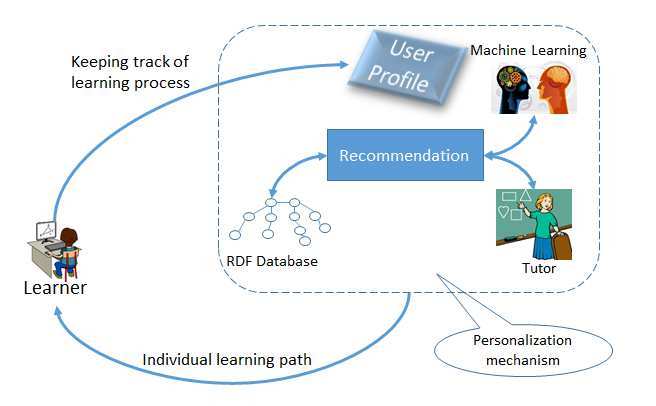
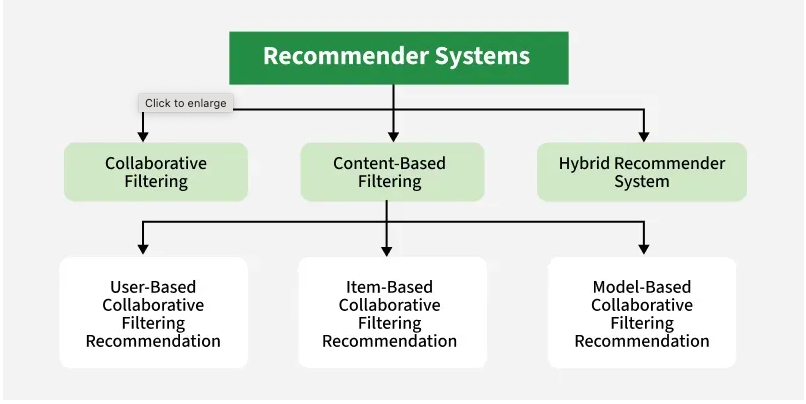
This approach focuses on developing personalised learning resources through content recommendation techniques. It is achieved through the use of technologies such as personalised recommendation systems, which provide learners with tailored learning suggestions based on their individual needs and characteristics, such as learning styles, behaviour, or preferences. These systems use various methods to recommend learning resources by analysing learner data, including learner characteristics and interactions with learning activities, in order to predict and deliver personalised content that supports adaptive learning experiences.
Resources
- https://www.geeksforgeeks.org/machine-learning/what-are-recommender-systems/
- https://marutitech.medium.com/what-are-the-types-of-recommendation-systems-3487cbafa7c9
References
- Chen, C.-M. (2009). Personalized e-learning system with self-regulated learning assisted mechanisms for promoting learning performance. Expert Systems with Applications, 36(5), 8816–8829. https://doi.org/10.1016/j.eswa.2008.11.026
- Chen, C.-M., Chen, Y.-Y., & Liu, C.-Y. (2007). Learning performance assessment approach using web-based learning portfolios for e-learning systems. IEEE Transactions on Systems, Man and Cybernetics Part C: Applications and Reviews, 37(6), 1349–1359. https://doi.org/10.1109/TSMCC.2007.900641
- Chen, C.-M., Lee, H.-M., & Chen, Y.-H. (2005). Personalized e-learning system using Item Response Theory. Computers and Education, 44(3), 237–255. https://doi.org/10.1016/j.compedu.2004.01.006
- Chrysoulas, C., & Fasli, M. (2017, April). Building an adaptive e-learning system. In CSEDU 2017 - Proceedings of the 9th International Conference on Computer Supported Education (Vol. 2, pp. 375–382).
- Dascalu, M.-I., Bodea, C.-N., Moldoveanu, A., Mohora, A., Lytras, M., & de Pablos, P. O. (2015). A recommender agent based on learning styles for better virtual collaborative learning experiences. Computers in Human Behavior, 45, 243–253. https://doi.org/10.1016/j.chb.2014.12.027
- Jeong, H.-Y., Choi, C.-R., & Song, Y.-J. (2012). Personalized learning course planner with e-learning DSS using user profile. Expert Systems with Applications, 39(3), 2567–2577. https://doi.org/10.1016/j.eswa.2011.08.109
- Juškevičiene, A., & Kurilovas, E. (2014). On recommending Web 2.0 tools to personalise learning. Informatics in Education, 13(1), 17–31. https://doi.org/10.15388/infedu.2014.02
- Kaiss, W., Mansouri, K., & Poirier, F. (2022). Personalized e-learning recommender system based on a hybrid approach. 2022 IEEE Global Engineering Education Conference (EDUCON), 1621–1627. https://doi.org/10.1109/EDUCON52537.2022.9766650
- Laeeq, K., Memon, Z. A., Abbasi, M. A., Awan, S. A., & Khan, A. A. (2024). Integrated modular approach to provide optimized VLE for learners’ engagement. Multimedia Tools and Applications. https://doi.org/10.1007/s11042-024-20100-6
- Nacheva-Skopalik, L., & Green, S. (2012). Adaptable personal e-assessment. International Journal of Web-Based Learning and Teaching Technologies, 7(4), 29–39. https://doi.org/10.4018/jwltt.2012100103
- Smaili, E. M., Khoudda, C., Sraidi, S., & Charaf, M. E. H. (2022). An innovative approach to prevent learners’ dropout from MOOCs using optimal personalized learning paths: An online learning case study. Statistics, Optimization & Information Computing, 10(1), 45–58. https://doi.org/10.19139/soic-2310-5070-1206
- Tang, Y., & Wang, W. (2018). A literature review of personalized learning algorithm. Open Journal of Social Sciences, 6(1), 119–127.
- Wanapu, S., Fung, C. C., Kerdprasop, N., Chamnongsri, N., & Niwattanakul, S. (2016). An investigation on the correlation of learner styles and learning objects characteristics in a proposed Learning Objects Management Model (LOMM). Education and Information Technologies, 21(5), 1113–1134. https://doi.org/10.1007/s10639-014-9371-3
- Xie, H., Zou, D., Zhang, R., Wang, M., Meng, W., & Kwan, R. (2019). Personalized word learning for university students: A profile-based method for e-learning systems. Journal of Computing in Higher Education, 31(2), 273–289. https://doi.org/10.1007/s12528-019-09215-0